Bioceramic Sealer RCT
Modern bioceramic fillings
Traditional root canals seal the tooth using gutta-percha cones combined with paste sealers that can shrink slightly over time, leaving microscopic gaps. Bioceramic sealers are a major leap forward: highly biocompatible, they bond chemically to the tooth structure, expand slightly on setting, and actively release calcium ions to promote bone healing and kill residual bacteria.
Chemical bonding & tissue regeneration
We use premium, medical-grade calcium silicate-based bioceramic sealers. These materials use the moisture within your tooth dentine to set, forming a chemical bond that hermetically locks the root canal system.
Zero-shrinkage seal
Slight expansion on setting eliminates micro-leakage and bacterial entry.
Active healing support
Releases calcium hydroxide, stimulating natural bone repair at the root tip.
High alkalinity (pH 12+)
Provides a strongly antibacterial environment while setting.
Who is it for?
- Patients seeking the longest-lasting seal for their root canal
- Teeth with thin, weakened root walls that need strengthening
- Individuals with a history of allergy to traditional epoxy sealers
- Cases with bone lesions that require tissue-regeneration support
What to expect
For the patient, the procedure feels identical to a standard root canal. At the final step, instead of standard cement, the dentist fills the canal with a smooth bioceramic paste that uses the tooth’s natural moisture to set, forming a strong chemical bond.
Performed at Shwetha Dentistry by our specialist endodontic team.
The Procedure, Step by Step
Exactly what happens during your bioceramic sealer rct — no surprises.
Canal Shaping & Cleaning
Canal Shaping & Cleaning
Preparing the root canals to receive the bioceramic filling.
The root canals are prepared using flexible rotary files and flushed with antibacterial irrigants. The canals are carefully shaped to let the bioceramic paste flow into the entire space.
Shaping creates a clean channel that allows the sealer to make full contact with the dentine walls.
Controlled Dehydration
Controlled Dehydration
Drying the canals while keeping slight moisture to trigger the setting reaction.
The shaped canal is dried using sterile paper points. Unlike traditional sealers that require absolute dryness, bioceramics need a trace of moisture inside the dentinal tubules to activate their setting chemistry.
This trace moisture triggers the chemical hydration reaction that sets the sealer.
Sealer Injection
Sealer Injection
Injecting the smooth bioceramic paste directly into the root canal system.
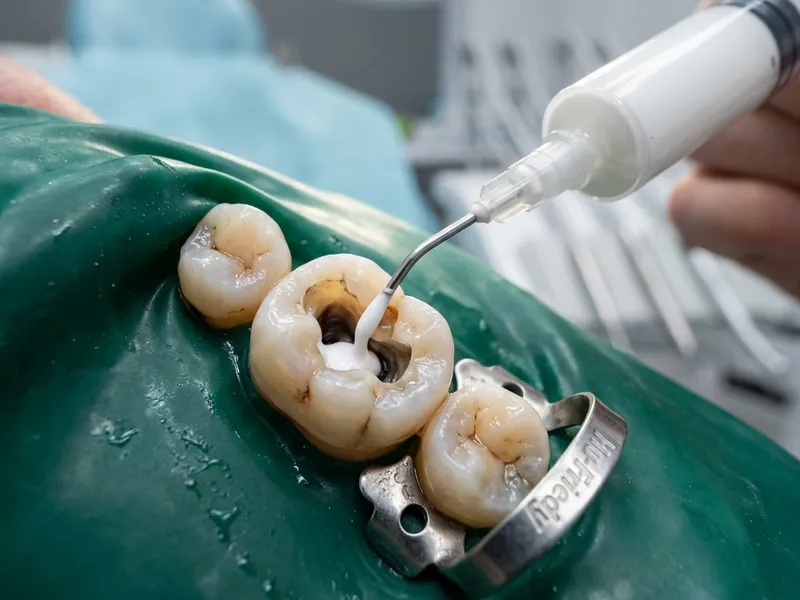
A premixed, medical-grade bioceramic paste is injected into the root canal using a fine micro-tip. Its smooth flow lets it penetrate accessory canals and microscopic crevices.
This ensures that all voids and branches of the canal system are filled.
Cone Placement
Cone Placement
Inserting a customised gutta-percha cone to coat the canal walls.
A matching gutta-percha cone, coated with a thin layer of bioceramic sealer, is inserted to the full length of the canal. The cone acts as a core, pressing the sealer against all canal walls.
This creates a solid core wrapped in a chemically bonded bioceramic seal.
Curing & Hydroxyapatite Bonding
Curing & Hydroxyapatite Bonding
The sealer reacts with tooth minerals to form a permanent bond.
Over the next couple of hours, the bioceramic paste reacts with the moisture and calcium minerals in the dentine, forming hydroxyapatite crystals that grow and lock into the dentinal tubules — creating a single, solid structure.
This chemical bond reinforces the root, restoring strength to the tooth structure.
Treatment Cost
₹5,500 – ₹7,500
1 visit (45–60 minutes)
Indicative range — please consult the dentist; the exact price varies from case to case.
Aftercare
- Avoid biting hard on the tooth until a permanent crown is placed.
- Maintain standard oral hygiene with gentle flossing.
- Minor sensitivity during the setting phase (first 48 hours) is normal; manage it with standard relievers.
- Attend your follow-up appointment to check the healing of the bone.
Frequently Asked Questions
Traditional sealers are based on epoxy resins or zinc-oxide eugenol, which shrink and degrade over time. Bioceramics do not shrink or degrade, are non-toxic, and actively help the bone heal.
Yes. Bioceramics are extremely biocompatible and mimic the natural chemical composition of bone and teeth. They do not cause allergic reactions or tissue rejection.
For the patient, the experience is exactly the same. The difference lies in the material we inject to seal the canals at the final stage of the root canal.
No. Once set, bioceramics are highly insoluble and resistant to degradation, maintaining a permanent seal inside the root canal for decades.
Because bioceramics are non-toxic and tissue-friendly, they cause significantly less post-operative irritation than traditional chemical cements, even if a tiny amount passes the root tip.
Yes. By chemically bonding to the dentine walls, bioceramic sealers help hold the root structure together, improving the tooth’s resistance to fractures.
The sealer begins to set within 2 to 4 hours using the moisture within the tooth, reaching its final hard state within 24 to 48 hours.
Yes — it is excellent for all root canal cases, and particularly beneficial for teeth with wide root ends, internal root damage or weakened structures.
Although the seal is very strong, bioceramic fillings can be safely removed using standard endodontic retreatment tools and ultrasonic tips if ever needed.
It releases calcium and hydroxide ions, creating an alkaline environment that kills bacteria and stimulates bone-building cells (osteoblasts) to repair damage at the root tip.