Rotary & Reciprocating RCT
Automated NiTi files
This advanced root canal therapy uses highly flexible, engine-driven nickel-titanium (NiTi) files instead of traditional stainless-steel hand files. The flexibility of NiTi allows the instrument to navigate even severely curved root canals with exceptional precision and safety, resulting in a smoother, faster and more comfortable patient experience.
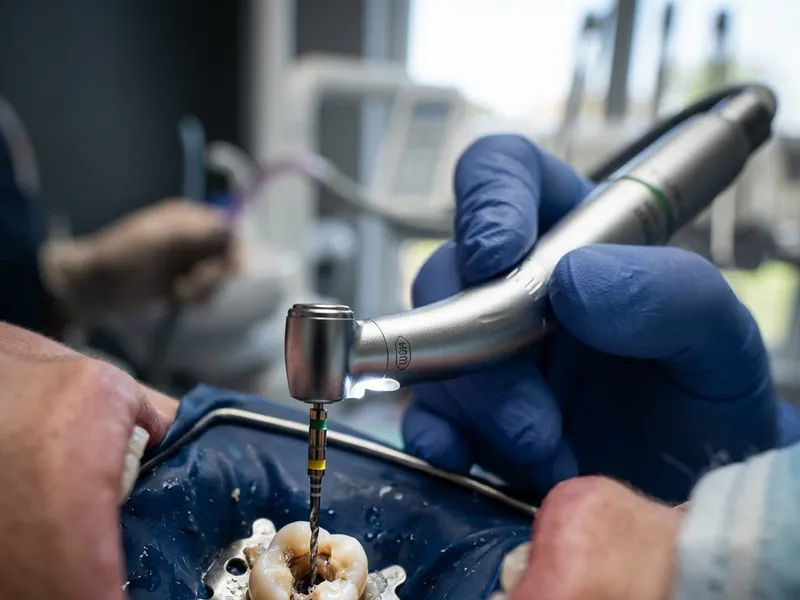
Automated precision endodontics
At Shwetha Dentistry, we use advanced wireless endodontic motors with integrated apex locators. Continuous torque feedback prevents file separation, delivering clinical accuracy unmatched by typical clinics.
Gen-5 endodontic motors
Continuous torque control minimises the risk of file fracture.
Integrated apex locators
Real-time depth measurements prevent over-filling.
Optimised speed settings
Calibrated specifically for your individual tooth anatomy.
Who is it for?
- Patients experiencing severe decay reaching the pulp
- Teeth with curved or narrow root canals
- Patients seeking a quick, single-visit treatment
- Individuals with a low pain threshold who need gentle care
What to expect
During the procedure, the tooth is completely numbed using local anaesthesia. You will feel no pain, only slight pressure. The rotary motor runs quietly with minimal vibration, and you can rest comfortably while our endodontist completes the cleaning with automated files.
Performed at Shwetha Dentistry by our specialist endodontic team.
The Procedure, Step by Step
Exactly what happens during your rotary & reciprocating rct — no surprises.
3D Isolation & Access
3D Isolation & Access
Isolating the tooth with a rubber dam, then creating a conservative access cavity.
First, the tooth is isolated from the rest of the mouth using a sterile rubber dam. This prevents saliva contamination and provides a clean field. A precise, conservative cavity is then made through the crown to expose the pulp chamber.
This step keeps the treatment clean and sterile, maximising the success rate of the disinfection process.
Digital Apex Mapping
Digital Apex Mapping
Using electronic apex locators to measure the exact length of the canals.
Fine digital diagnostic files connected to an electronic apex locator determine the exact location of the root tip (apex), ensuring the cleaning reaches the very end without damaging surrounding tissues.
This eliminates the guesswork associated with traditional X-rays, giving a highly accurate map of the canals.
Automated Shaping
Automated Shaping
Engine-driven rotary NiTi files shape and clean the canal systems.
Advanced engine-driven nickel-titanium files are inserted into the canals. Driven by a micro-motor, they rotate and reciprocate to shape the canals smoothly and remove infected pulp tissue efficiently.
The flexible files adapt to curved canal shapes, protecting the integrity of the natural tooth structure.
Fluid Irrigation & Debridement
Fluid Irrigation & Debridement
Flushing the canals with warm sanitising liquids to remove remaining bacteria.
Warm sanitising irrigants are applied into the canals and activated using sonic vibrations to flush out organic debris and disinfect microscopic side branches that files cannot physically touch.
This deep chemical disinfection ensures no bacteria remain behind to cause future infection.
Biocompatible Sealing
Biocompatible Sealing
Sealing the prepared canals permanently with gutta-percha and sealer.
Once clean and dried, the canals are filled with matching gutta-percha cones and a thin layer of antibacterial sealer. The access cavity is then sealed with a temporary composite restoration.
The tight, three-dimensional seal prevents any future micro-leakage or entry of oral bacteria.
Treatment Cost
₹4,500 – ₹6,500
1 visit (45–60 minutes)
Indicative range — please consult the dentist; the exact price varies from case to case.
Aftercare
- Avoid biting or chewing on the treated tooth until it is fully restored with a permanent crown.
- Maintain standard brushing and flossing routines around the area.
- Take over-the-counter anti-inflammatory relievers if you experience minor tenderness for 2–3 days.
- Eat soft foods for the first 24 hours after treatment.
Frequently Asked Questions
No. Local anaesthesia is applied first to fully numb the area. The rotary motor operates smoothly and quietly, so you feel only slight pressure — much like a standard filling.
Yes. In most cases, unless there is severe active swelling or a complex infection, rotary endodontics allows us to complete the entire procedure in one visit of about 45 to 60 minutes.
Traditional RCT uses stiff hand files that require a back-and-forth filing motion, which takes longer and can be less precise in curved canals. Rotary RCT is automated, faster, safer and cleaner.
Our endodontic motors feature built-in torque control. If the file encounters resistance, it automatically reverses or stops, reducing the risk of fracture to virtually zero.
Yes. A crown is highly recommended after any root canal treatment to protect the brittle tooth structure from cracking under chewing forces.
The local anaesthesia keeps your lip, cheek and gums numb for about 2 to 3 hours. Avoid hot beverages or chewing until the feeling returns.
Yes. Standard local anaesthesia does not affect your awareness or reaction times, so it is completely safe to drive or return to work.
Yes, with proper precautions. Root canal treatment is safe during pregnancy, particularly in the second trimester. We use lead aprons for X-rays and select safe anaesthetics.
Rotary endodontics has a success rate of over 95% when performed by a specialist — one of the most reliable dental procedures.
You can eat once the anaesthesia wears off completely. Chew on the opposite side of your mouth and avoid hard, crunchy foods for the first day.